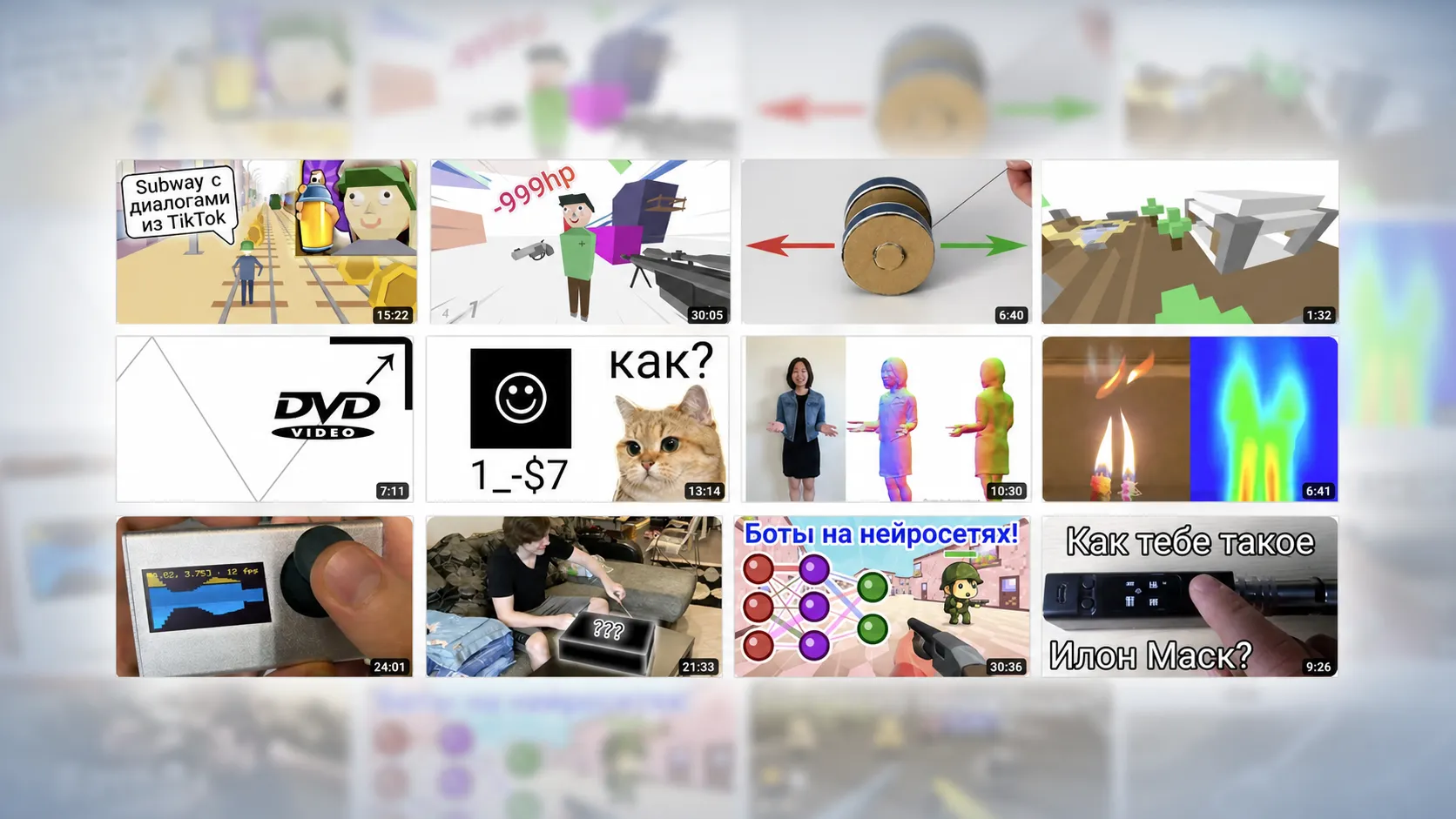
Vectozavr has never been a channel about one school subject. It is about the moment when an abstract idea becomes something you can see, build, break, and finally understand.
I might begin with Boolean logic and end with a computer assembled from transistors. I might begin with ray casting and end with a playable shooter. A compact formula might turn into an animated fractal landscape; a question about machine learning might turn into bots fighting inside a game I wrote myself. The catalogue looks eclectic, but the method behind it is remarkably consistent: make the project first, then tell the story of how it works.
That method took a small educational blog into videos watched millions of times. By August 2026, Vectozavr had grown past 200,000 subscribers and 18 million channel views—not through daily uploads, but through a relatively small collection of ambitious, visual explanations.
Rounded from the public YouTube channel figures checked on August 7, 2026.
Before Vectozavr had a name
YouTube says the underlying account joined in 2011, but that is account history rather than the beginning of Vectozavr as a project. The oldest public upload is a recording of my presentation at the 2016 International Young Physicists’ Tournament. It is a useful piece of prehistory: before the animation, engineering builds, and polished thumbnails, there was already an urge to investigate a problem and explain the result.
In 2017, I started ilinblog.ru, an educational site where I could publish articles, simulations, and research notes. Video grew out of that project. My January 2019 episode about writing a pseudo-3D game in a terminal still introduces the channel as ilinblog and points viewers to a companion article. The website held the derivation and code; the video supplied movement, intuition, and a story.
The Vectozavr identity appeared gradually rather than in one clean launch. Public profiles from 2019 used the transitional name “Vectozavr — ilinblog,” and the old blog name remained in early descriptions while the new one spread across YouTube, GitHub, and the community channels. By 2020, Vectozavr had become the name people recognized. What began as a place to publish my notes had turned into a recognizable style of science and engineering storytelling.
- A public starting pointAn IYPT presentation becomes the oldest surviving video on the account.
- ilinblog becomes the foundationI build an educational site for articles, experiments, simulations, and source code.
- The Vectozavr format appearsA pseudo-3D game turns ray casting, old game engines, and my own code into one narrative.
- A computer built from the bottom upA four-bit adder makes binary arithmetic and Boolean logic physical—and brings the channel its first multi-million-view build story.
- The subjects expandFractals, neural-network bots, physics, and a homemade game console establish the channel’s range.
- The audience passes 100,000YouTube’s Silver Creator Award turns a number on a screen into a physical milestone for the channel.
- From episodes to larger worldsVectozavr Academy launches, and the 3Dzavr engine becomes a downloadable online shooter.
- The channel follows my researchNewer uploads revisit IYPT, explain LLM-pruning research, and reflect on building educational products.
When a number became something I could hold
On October 21, 2020, I posted a screenshot of the channel at 99,135 subscribers with a slightly disbelieving question: were we really about to reach 100,000? Until then, the audience mostly existed as a counter beside the videos—large enough to be exciting, but still strangely abstract.
Crossing the line brought something tangible: YouTube’s Silver Creator Award for Vectozavr. The plaque did not change how the next project had to be built or how the next explanation had to work, but it made the scale of the audience briefly physical. A channel assembled from terminal graphics, soldered circuits, fractals, homemade games, and long nights of editing had travelled far enough to come back as an object I could hold.
The award belongs in the story because it marked more than subscriber growth. It showed that ambitious technical videos in Russian did not have to be simplified into quick facts to find an audience. People were willing to follow the full construction—the equations, the failed attempts, the source code, and the finished machine.
Four subjects, one kind of curiosity
The channel description names mathematics, physics, programming, and robotics. I do cover all four, but they are not separate departments. The most interesting videos happen where the boundaries disappear.
Mathematics becomes visible. Fractals are not introduced as definitions to memorize. A formula is animated, its parameters move, and suddenly the same rules resemble coastlines, lightning, crystals, or branching plants. Geometry becomes easier to trust when it controls a camera or changes a rendered world in real time. When I published the 2020 fractal episode during university exams, I wrote that the goal was not hype, but to contribute something new and inspire people. That is still a useful description of the channel at its best.
Physics becomes an experiment. Sometimes that means a real tabletop setup; sometimes it means a simulation where a hidden assumption can be isolated. The aim is the same: replace “this is the law” with “here is what changes when we touch the system.”
Programming becomes a way to expose machinery. A pseudo-3D renderer, a neural-network opponent, or an online game is entertaining on the surface. Underneath, each is an excuse to reveal an algorithm that commercial software usually keeps invisible.
Electronics makes computation tangible. A hand-soldered adder or a homemade console forces every abstraction to meet a wire, transistor, display, battery, or timing limit. You cannot wave away a mistake when the device is sitting on the table refusing to work.

A 3D game inside a terminal
Ray casting turns a two-dimensional map into the illusion of a world, making an old rendering trick understandable enough to rebuild.
Watch on YouTube ↗
A computer built from transistors
Binary arithmetic moves off the page and onto a hand-built board: gates, adders, mistakes, and a working four-bit result.
Watch on YouTube ↗
Fractals, animated from the rule up
Complex numbers, random walks, aggregation, and the Laplace equation become an animated tour of patterns that recur in nature.
Watch on YouTube ↗
A console that runs my own games
An Arduino, screen, joystick, custom board, case, and rewritten game engine become a pocket-sized system people can actually play.
Watch on YouTube ↗The real unit of work was the project
In a 2026 retrospective, I described the workflow plainly: I would make a project, wait several months, then record and edit the video about it. That gap matters. The episode was not a promise about something I hoped to build. It was a reconstruction made after the prototype, wrong turns, funny failures, and final result already existed.
This is why the channel could publish infrequently and still feel substantial. The computer video was backed by a real four-bit adder. The homemade console was a working Arduino GameBoy. The early terminal game grew into a pseudo-3D shooter, then a true 3D engine and online FPS. Code and articles were not bonus material added for credibility; they were the substrate from which the story was made.
In one case, the project had been waiting behind the channel for years. In January 2021, I wrote that I had finally begun “the project from which the thoughts of the channel began”; the next update revealed a 3D engine. What started as a university C++ project eventually became 3Dzavr, a multiplayer game, and a 30-minute build story. The channel had grown partly around the dream of making that video before the engine itself was ready.
Building first also protected the videos from becoming frictionless success stories. A project provides resistance: components arrive late, code runs too slowly, a bot learns the wrong behavior, a circuit needs a jumper wire, or a renderer produces a spectacularly broken frame. Those moments are not distractions from the explanation. They show where the real understanding had to happen.
When a channel became a school
By 2021, the videos had revealed both the strength and the limit of the format. A good episode can make one difficult idea memorable, but it cannot give a learner a complete route through vectors, matrices, transformations, cameras, and projection. It has no exercises, progress, or next lesson.
Vectozavr Academy was my attempt to carry the channel’s visual language into a structured course. The original linear-algebra and 3D-graphics program used interactive scenes and programming outcomes so that mathematics always led somewhere visible. It launched publicly in April 2022, turning the Vectozavr name from a media identity into an educational product and eventually my first meaningful business.
The relationship went both ways. The channel gave the school an audience and a recognizable philosophy; building the school gave the channel a larger story to follow. The same name now connects videos, open-source projects, and an ongoing experiment in how difficult technical ideas should be taught.
A changing channel, not a finished one
The densest period of Vectozavr uploads ran from 2019 through 2022. After I moved abroad and began graduate research, the cadence changed. The public questions changed too: a 2024 video returned to IYPT, a 2025 seminar explained efficient pruning of large language models, and the 2026 retrospective spoke directly about startups, attention, and the cost of choosing one path over another.
That shift makes the catalogue less tidy, but more honest. Vectozavr is not a perfectly optimized content niche. It is a record of what I was trying to understand at different stages of my life—from a console renderer and a soldered calculator to game engines, educational software, and machine-learning research.
I still think the older formula is the right one: do something real enough to resist a neat explanation, then find the visual story hiding inside it. If Vectozavr has a subject, it is not simply mathematics, physics, programming, or robotics. It is learning in public by making the invisible machinery visible.
What making Vectozavr taught me
- An artifact gives an explanation stakes. “Here is how an adder works” becomes more convincing when the adder must work by the end of the video.
- Animation is a reasoning tool. Movement can expose a transformation, dependency, or failure that a static diagram leaves abstract.
- The boundaries between subjects are often the best part. The memorable projects joined mathematics to graphics, electronics to programming, or machine learning to game design.
- A small catalogue can have a long life. Project-led videos take longer to produce, but people can still discover them years after publication because the underlying question remains interesting.
- Explaining a project changes the next project. The visual, interactive style developed for YouTube later shaped the Academy, while the Academy and my research gave the channel new questions.
Project trail
- Explore the Vectozavr channel
- Watch the pseudo-3D episode that established the format
- See the four-bit computer build
- Watch neural-network bots learn to fight
- Follow the complete 3D-engine and online-shooter story
- Watch my 2026 retrospective on products, research, and attention
- Browse the open-source projects behind the videos