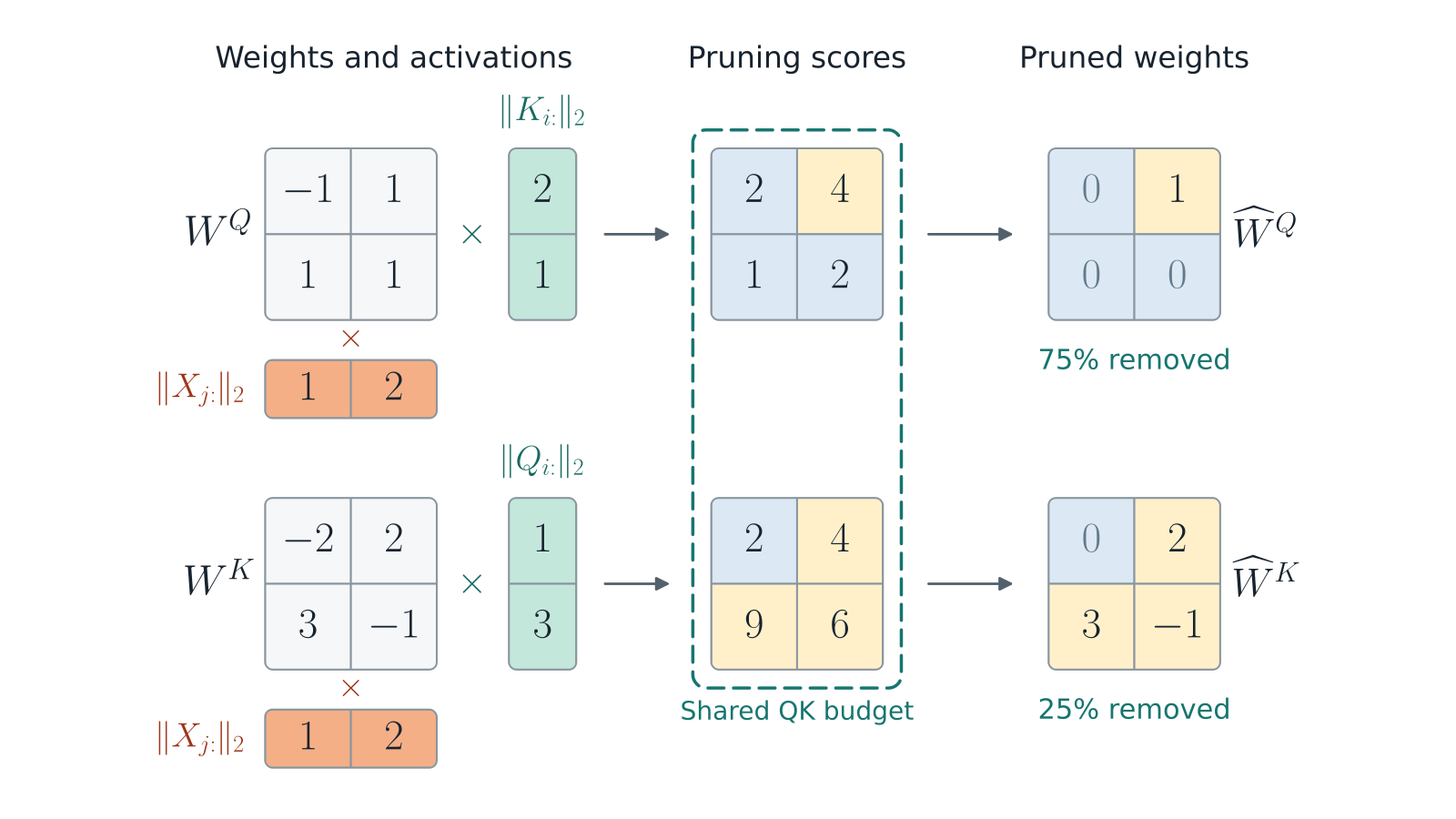
Wanda scores weights in each linear projection independently. But in attention, a query matters through the keys it meets, and a key matters through the queries. Can we use that interaction when deciding which weights to remove?
QK-Wanda is a simple extension of Wanda that measures how weight deletions affect query–key dot products. The method uses calibration forward passes, keeps surviving weights fixed, and needs no gradients or retraining.
From Wanda to query–key reconstruction
Let contain one calibration sequence, with one token per column. For a linear projection , Wanda measures the cost of deleting through its change to the projection output:
Deleting just that weight changes output row by . Its exact squared cost is
This is the square of Wanda’s familiar score , so it produces the same ordering. Standard Wanda removes the lowest-scoring weights within each output row.
Now consider one query–key head pair in ordinary multi-head attention, with head width . Write
The dot products determine how queries and keys interact. For this simple case, we reconstruct those products directly:
Hats denote pruned projections evaluated on the same inputs. We use raw dot products here; including the usual attention scale would divide every squared deletion cost by and preserve the ranking.
The score gains one factor
Delete while keeping the keys and all other weights fixed. The change to the product is an outer product:
The squared Frobenius norm of an outer product is the product of the squared vector norms. Thus the query deletion cost, and the symmetric key deletion cost, are
QK-Wanda is Wanda multiplied by the energy of the opposite projection. A query weight receives a larger score when its coordinate interacts with strong keys; a key weight receives a larger score when it interacts with strong queries.
Both costs measure damage to the same objective, so we can pool them and remove the smallest scores under one shared QK budget per transformer block. The surviving values stay unchanged.
For this single-sequence example, the extra factor is constant within each row. With the same row quotas and nonzero opposite-projection energies, the ordering—and therefore the mask—would match Wanda. The new factor matters when comparing weights across rows and between Q and K. With several independent calibration sequences, we average their deletion costs before selecting the mask.
The cover uses the repository’s one-token example, . Both methods remove four of eight weights. Wanda removes half of each row; QK-Wanda removes three query weights and one key weight. The resulting squared QK error is 81 with Wanda and 9 with QK-Wanda. The illustrated scores are square roots of the costs above, which preserves their ordering.
Results against Wanda
We evaluate 15 checkpoints from TinyLlama, Llama 2, Llama 3, and Qwen2.5, spanning 0.5B–72B parameters. The main comparison uses the same C4 calibration tokens for both methods and prunes only query and key weights; all other parameters stay dense. Wanda uses row budgets, while QK-Wanda shares a QK budget per block.
Across the 15 checkpoints, the mean relative reduction in QK reconstruction error is 60.35% at 50% QK sparsity and 44.70% at 80%. The following results show the three largest checkpoints at 80% QK sparsity:
Wanda vs QK-Wanda
80% query–key sparsity · all other parameters stay dense
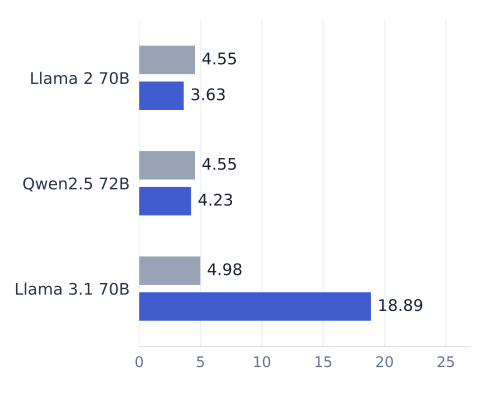
WikiText-2 perplexity ↓
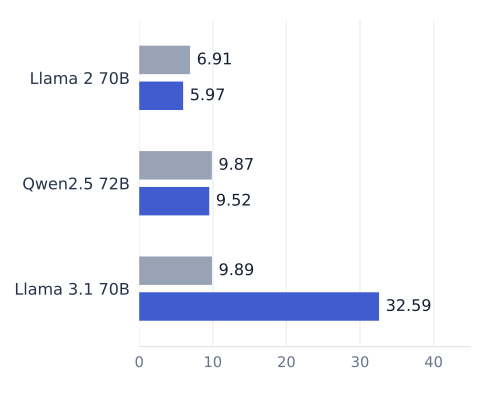
C4 perplexity ↓
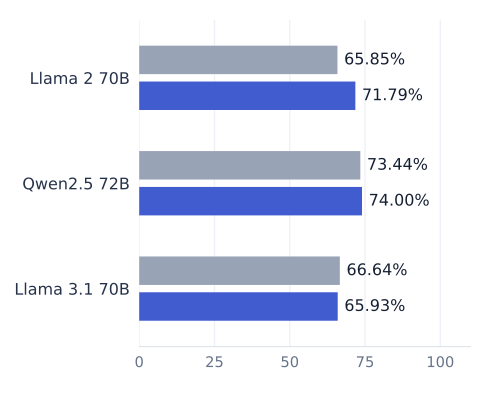
Mean zero-shot accuracy (%) ↑
Relative squared QK error (%) ↓
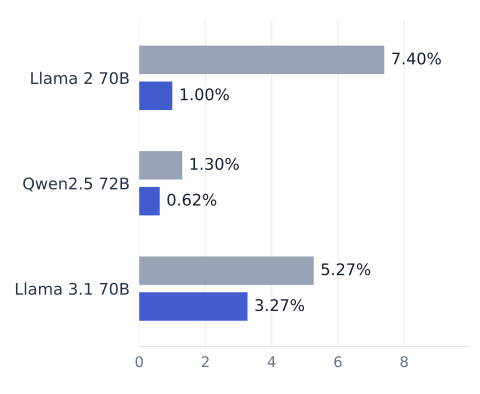
Accuracy is the unweighted mean over seven zero-shot tasks; QK error is the block-mean relative squared reconstruction error. These benchmarks include architectures beyond the ordinary MHA example derived above.
On Llama 2 70B, this gives 20.3% lower WikiText-2 perplexity, 13.5% lower C4 perplexity, and a 5.94 percentage-point gain in mean accuracy relative to Wanda. The method is also inexpensive: full-block pruning, using QK-Wanda for Q/K and Wanda for the other projections, took 1.3% longer than Wanda on A100 and 3.1% longer on H200 with the main calibration setup.
Better local reconstruction does not guarantee a better complete model. Llama 3.1 70B illustrates that clearly: its QK error improves while perplexity worsens. The scores are exact for an individual deletion with everything else fixed; selecting many deletions uses an additive surrogate, whose costs need not equal their joint error.
The arXiv preprint contains the full derivations, architecture extensions, ablations, and evaluation details. The GitHub repository provides the implementation and reproduction instructions.